If you want a workout that builds real ability, not just sweat, martial arts might be the most Austin-friendly training you can do.
Austin is full of people who like to move, but not everyone wants another treadmill routine or a crowded weight room at peak hours. If you hike the Greenbelt, paddle on Town Lake, or sit at a desk all day and try to “make up for it” later, you already know the problem: a lot of fitness feels repetitive, and it does not always translate to anything you can actually use.
That is where martial arts change the whole equation. You still get the conditioning, strength, and mobility work you want, but you also get a skill. We train with structure, clear goals, and a focus on technique so your time in class turns into progress you can feel week to week.
Even better, martial arts fit Austin’s lifestyle because you can train hard without needing to smash your joints every session. With smart coaching and a clean progression, you can show up consistently, improve, and still have energy for the rest of your life.
Why martial arts work so well for Austin’s pace
Austin runs on a mix of ambition and activity. Tech schedules are real, traffic is real, and weekends fill up fast. The best workout is usually the one you will actually stick to, and martial arts give you built-in reasons to come back: learning, problem-solving, community, and measurable skill development.
From an exercise standpoint, you are getting a full-body training stimulus. You move your hips, spine, shoulders, and legs in coordinated patterns. You push, pull, brace, breathe, and reset under pressure. That combination is hard to replicate in a single gym session unless you are extremely dialed in.
From a lifestyle standpoint, training gives you a “reset button.” You walk in with work stress in your head and leave with a calmer nervous system because your attention was forced into the present. It is not magic, but it is pretty close to mental clarity.
Brazilian Jiu-Jitsu: high output, low ego, real skill
When people say they want martial arts as a workout, what they often mean is: “I want to get in shape, but I also want to learn something that matters.” Brazilian Jiu-Jitsu, especially no-gi grappling, is one of the cleanest answers to that goal.
BJJ is a problem-solving art. You learn how to control distance, posture, and balance, and you learn how to escape bad positions without panicking. It is technical and precise, but it is also scalable. You can train at a sustainable intensity and still get a brutal workout, because grappling taxes your whole body and your cardio system in a way that feels uniquely honest.
Industry participation in martial arts has surged in recent years, with many reports pointing to strong growth from 2020 through 2024. We see the same thing locally: more adults want training that blends fitness with capability, and grappling fits that trend because it rewards consistency over athletic background.
Martial arts in Austin: why the city keeps pulling people onto the mats
Martial arts in Austin are a natural match for the city’s culture. People here like experiences, not just products. A class is an experience. You learn, you struggle a little, you get better, and you share the room with people doing the same thing.
Austin is also full of “mixed fitness” people. You might lift a couple days a week, run once, hit a yoga class, and then want something that ties everything together. Grappling does that because it demands:
• Strength you can apply while moving and resisting
• Cardio that works in bursts, not just steady-state jogging
• Mobility you can use under real pressure, not just passive stretching
• Coordination and timing that improve with practice
• Mental resilience that shows up outside training, too
And practically speaking, if your schedule changes week to week, structured classes help. You show up, follow the plan, and leave knowing you did something worthwhile.
What makes this training feel different than “just working out”
A lot of workouts give you fatigue. Martial arts give you feedback.
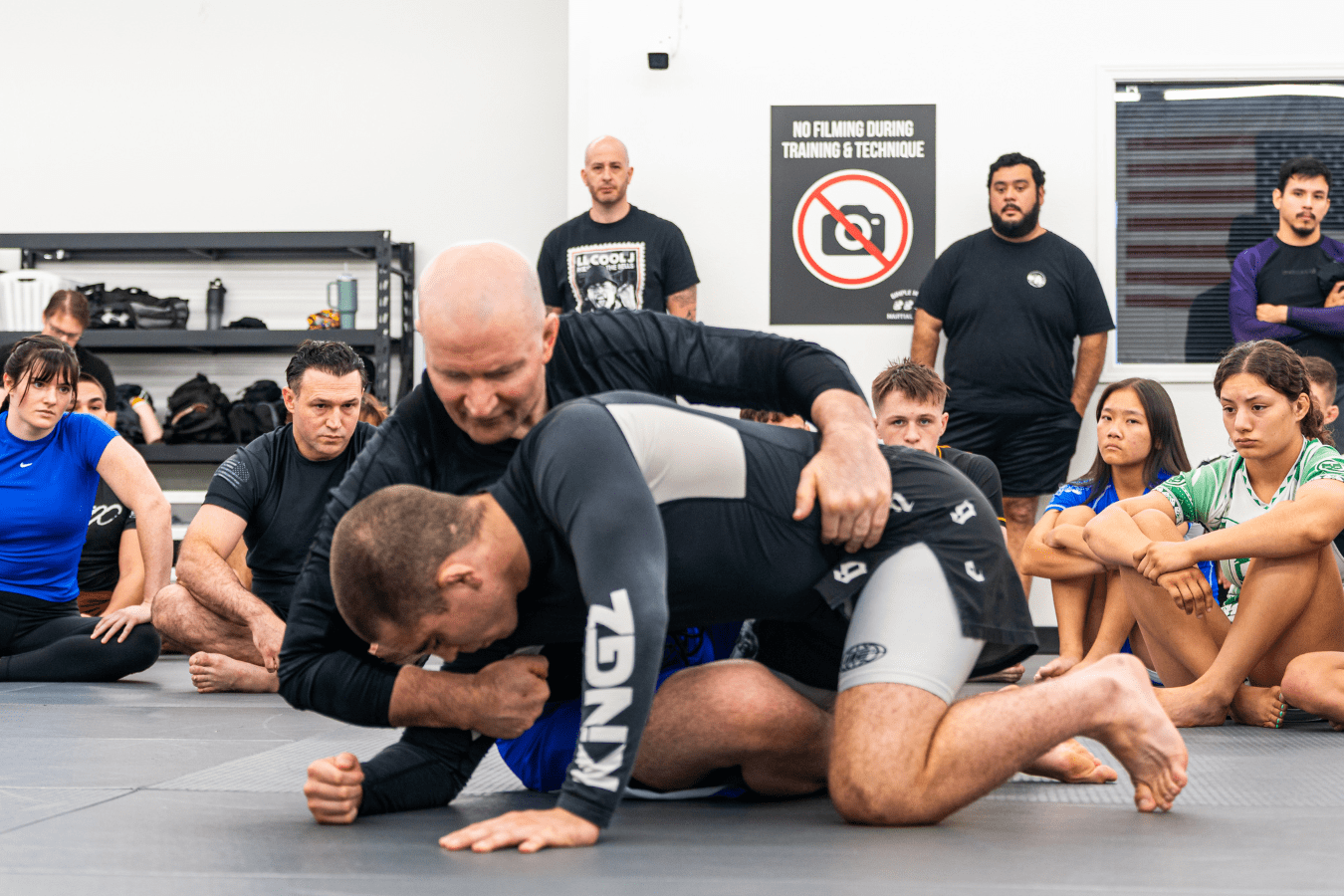
In a typical session, you are not only burning calories. You are learning positions, timing, and decision-making. Your partner gives you real resistance, but the room stays controlled because training is guided and progressive. That feedback loop is why people stick with it. You can track progress in small, satisfying ways: cleaner escapes, better balance, fewer panicked moments, more efficient movement.
We also keep training simple on purpose. That does not mean easy. It means clear. You will drill, you will refine details, and you will practice applying those details in live rounds so your skills hold up when things speed up.
How our classes fit beginners without slowing down the room
Most adults hesitate because they think they need to “get in shape first.” You do not. You get in shape by training, and we build the on-ramp so you can start safely and actually enjoy the process.
Our Fundamentals Program is designed for people with no experience. We teach the core positions and movements that make everything else easier: how to base, how to frame, how to breathe under pressure, how to escape, how to control. You do not need to be explosive. You need to be consistent.
For more experienced students, the room stays challenging because technical depth never runs out. As you improve, the same positions become more detailed: finer angles, cleaner entries, better transitions, smarter pacing.
A realistic look at what you will feel in the first month
Week one usually feels like learning a new language while doing burpees. That is normal. You might be a little sore in places you did not know existed, especially your core, grip, and neck. Your cardio will get tested too, but it is not just “out of breath” cardio, it is “stay calm while working” cardio.
By week two or three, you start recognizing patterns. You stop freezing as often. You learn small wins, like escaping the bottom position or keeping your posture when someone tries to break it down.
By the end of the first month, most people notice a few consistent changes:
- Better conditioning without needing long workout sessions
- Improved hip and shoulder mobility from repetitive, functional movement
- More confidence in close contact and pressure situations
- A clearer sense of how to train with intention instead of randomly
It is not a dramatic movie montage. It is more like steady skill-building that sneaks up on you.
Why this is a smart option for desk-job bodies and weekend athletes
Austin has plenty of people who sit for work and then try to become an athlete at 6 pm. That can be a rough switch if your training is only high-impact running or heavy lifting with zero mobility.
Grappling asks you to move through ranges you have probably ignored: hip rotation, spinal control, scapular stability, and bracing while you breathe. Those qualities carry over into hiking, lifting, and even just feeling better in your day-to-day posture.
We also like that BJJ gives you intensity without requiring constant pounding. You can train hard while still managing recovery, which matters if you are also doing other activities around the city.
What you can expect from our coaching and training culture
Our instruction emphasizes technical precision, innovation, and simplicity. In practice, that means we do not bury you in complicated sequences just to look advanced. We focus on repeatable fundamentals, then we layer options as your timing improves.
You will also see training content that reflects what we actually do: live rounds, technique breakdowns, and the culture of the room. We share learning through media like vlogs and podcasts, including discussions on modern grappling, no-gi trends, and how competitors structure training. If you like to understand the “why” behind training decisions, that approach helps.
And even if you never plan to compete, the room benefits from high standards. Good training environments raise everyone’s level because details matter, partners are attentive, and the pace stays purposeful.
How to get started without overthinking it
You do not need a perfect plan before your first class. Start with a simple approach and let momentum build.
1. Check the class schedule and pick a day you can realistically repeat each week.
2. Show up a little early so we can help you get oriented and answer quick questions.
3. Focus on learning positions and staying relaxed, not “winning” anything.
4. After class, note one skill you want to improve next time, like posture or frames.
5. Stay consistent for a month before you judge your progress.
The hardest part is showing up the first time. After that, it becomes a habit, and habits are powerful in a city that moves fast.
Martial arts as the long-term workout you do not quit
The reason martial arts work as a go-to workout is simple: it stays interesting. Your body adapts, but the problems keep evolving because your partners evolve too. That creates long-term motivation without needing constant novelty gimmicks.
You will still get stronger and fitter, but the bigger win is that your fitness has a purpose. You learn how to move another human being, how to stay calm under pressure, and how to make good decisions while tired. Those are real-world qualities, not just gym numbers.
And in Austin, where schedules change and goals shift, training that can flex with your life is valuable. You can train for fitness, skill, stress relief, competition, or all of the above in different seasons.
Take the Next Step
If you are looking for martial arts in Austin, TX that match the city’s active lifestyle, we built our training to be efficient, skill-focused, and welcoming for adults at any starting point. You will get a full-body workout, but you will also gain a technical foundation you can keep building for years.
When you are ready to experience it in person, we would love to have you on the mats at Simple Man Martial Arts, where our class structure and coaching style keep the learning clear and the training honest.
Experience the supportive coaching and culture at Simple Man Martial Arts by joining a class today.