Real stress relief is hard to fake, and the right training gives you a place to put your mind and body back under your control.
Stress in Austin can feel oddly relentless: long workdays, constant notifications, traffic that tests your patience, and a calendar that fills itself. We hear it all the time from new students who want a healthy outlet that actually works, not just something that sounds good in theory. That is where Adult Martial Arts fits so well, because it does not ask you to “relax” through willpower alone. It gives you a repeatable practice that changes your physiology and your mindset.
Adult Martial Arts works as a stress buster because it combines intense physical effort with focused attention. In other words, your body gets the movement it is craving, and your brain gets a break from the spinning mental loops. Across the U.S., about 9.4 million adults participate in martial arts at least once a year, and roughly 18 million Americans train annually across all age groups. That kind of participation is not a fluke. People keep showing up because the benefits are real, and you can feel them after a single class.
In this guide, we will break down why Adult Martial Arts in Austin, TX is uniquely effective for stress relief, how disciplines like Brazilian Jiu-Jitsu and MMA help lower stress hormones like cortisol, and what to expect as a beginner so you can start with confidence.
Why stress feels “stuck” in modern life
Stress is not only a mental experience. It is a full-body state. When deadlines, conflict, or uncertainty pile up, your nervous system can stay in a low-level fight-or-flight mode for days. That shows up as tight shoulders, shallow breathing, poor sleep, irritability, and that “always on” feeling that makes it hard to focus.
We also see another pattern: many adults try to manage stress with activities that do not fully interrupt the day’s mental noise. A casual walk is great, but you can still replay your meeting in your head. A gym workout can help, but it often leaves plenty of room to scroll between sets. Stress relief improves when an activity is physical and mentally absorbing at the same time.
That is the first reason Adult Martial Arts is different. In class, you cannot multitask. Your attention has a job to do.
The science of why Adult Martial Arts lowers stress
The stress-busting effect is not mystical. It is mechanical. Intense training influences your hormones and neurotransmitters while giving your nervous system a safe “on ramp” and “off ramp” back to calm. Research and coaching experience both point to the same core idea: martial arts blends exertion with focus in a way that supports emotional resilience and reduces stress markers like cortisol.
Physical exertion that burns off stress chemistry
When you train, your heart rate climbs, your lungs work, and your muscles demand fuel. This helps regulate stress in a direct way: your body uses the same systems that stress activates, but with a healthy purpose. Over time, consistent training improves cardiorespiratory function, strength, flexibility, and balance, which are all areas that tend to decline under chronic stress.
That matters for adults because stress is not only “in your head.” It is also in your posture, your breathing, and your energy levels. Training gives you a way to rebuild the physical foundation that stress quietly erodes.
Focused problem-solving that quiets rumination
In grappling and striking, your brain is solving small problems quickly: distance, timing, frames, posture, breathing, leverage. That kind of attention pulls you out of rumination. You cannot relive an awkward conversation while you are learning how to escape a pin or keep your base.
This is one reason South Austin Jiu-Jitsu style training, especially Brazilian Jiu-Jitsu, is so popular with busy professionals. It demands presence. You walk in carrying the day, and you walk out feeling like you got your mind back.
Safe pressure that trains calm under intensity
One of the most useful stress skills is staying calm when things get hard. Martial arts gives you controlled exposure to pressure, then teaches you how to respond. In Brazilian Jiu-Jitsu, you might feel pinned, then learn that posture, frames, and breathing change everything. In MMA-style rounds, you learn to keep your technique when you are tired. That process builds real confidence because it is earned, not imagined.
Over time, your nervous system learns that intensity does not automatically mean danger. That lesson carries into meetings, parenting, and life in a fast-growing city.
Why Adult Martial Arts in Austin, TX fits the city’s wellness culture
Austin is a place where people care about health. You can feel it in the trail crowds, the weekend races, and the way conversations drift toward training, recovery, and mental clarity. But Austin also has unique stressors: growth, cost of living pressure, and demanding work in industries where the pace never really slows down.
Adult Martial Arts in Austin, TX fits because it is structured. You do not have to design your own stress plan. You show up, follow the class, and let the process work. There is something deeply relieving about that, especially for adults who spend all day making decisions.
There is also a community aspect that matters more than most people expect. Worldwide, over 150 million people practice martial arts regularly, and about 40 percent are women. That diversity reflects what we prioritize locally too: inclusive training where beginners can start without needing a certain “type” of body or background.
Choosing between BJJ and MMA for stress relief
People often ask what is “better” for stress: Brazilian Jiu-Jitsu or MMA. We coach both with stress management in mind, and the honest answer is that both work, just in different ways.
Brazilian Jiu-Jitsu: calm, control, and problem-solving
BJJ is an excellent stress buster because it rewards patience and technique. Many rounds feel like a moving puzzle, where small adjustments create big results. You get a lot of mental engagement without needing to go full speed every second. That makes it accessible for beginners and for adults who want intensity with control.
BJJ also builds a very specific form of confidence: you learn that you can stay composed in close contact and find solutions. That reduces anxiety for many adults because the training teaches you how to respond instead of freeze.
MMA: full-body intensity and emotional release
MMA training blends striking, clinch work, and grappling concepts. It tends to be more cardio-forward, which can be a powerful outlet when you feel “wired” from stress. Many adults love the directness of it: you move, you sweat, you learn practical skills, and you leave the class feeling lighter.
MMA is also a strong fit if your stress shows up as restlessness. The pace gives your nervous system a clear signal: we are working hard now, and we are recovering later.
What to expect in your first Adult Martial Arts class
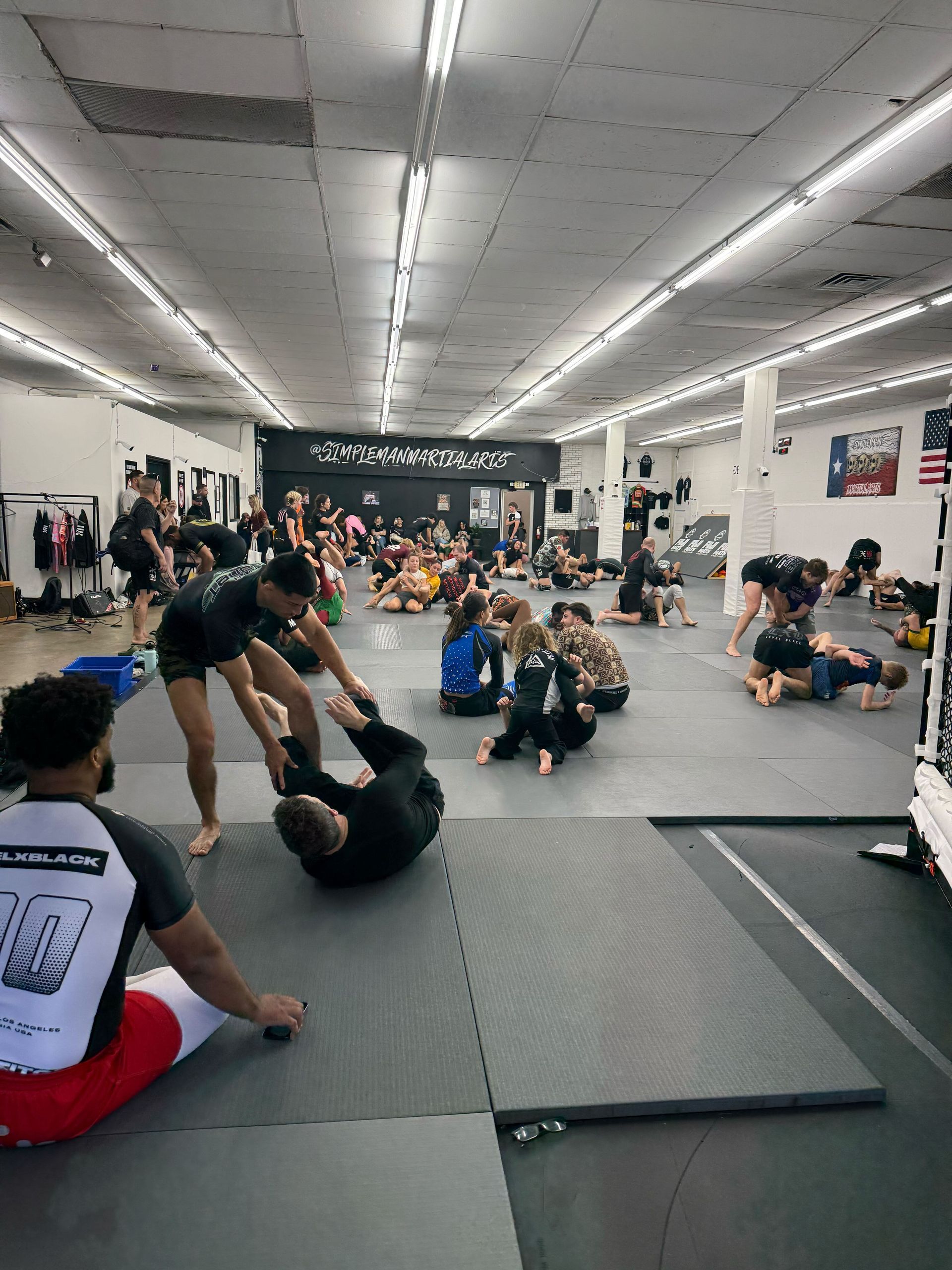
Starting something new can be stressful by itself, so we design the first experience to feel guided, not chaotic. You will learn fundamentals, move at a safe pace, and get clear coaching so you are not guessing what to do.
Here is what we focus on early so stress relief starts fast and stays sustainable:
• A warm-up that prepares joints and breathing without trying to “smoke” you on day one
• Clear foundational techniques that give you quick wins and a sense of progress
• Partner drills that emphasize control, communication, and safety
• Optional intensity levels so you can scale up gradually as confidence grows
• A cool-down mindset that helps you leave class calmer than you arrived
If you are worried about being out of shape, you are not alone. Most adults begin with a mix of excitement and nerves. Our job is to help you build a routine that feels challenging but doable.
Safety, longevity, and training for older adults
A common question we hear is, “Is martial arts safe for beginners or older adults?” Yes, when it is coached properly and approached with smart progression. The goal is not to win a workout. The goal is to train for years.
Research supports what we see on the mats: martial arts training in older adults can significantly improve balance, strength, flexibility, and cardiorespiratory function. Those improvements matter for stress management because physical capability is protective. When your body feels steadier and stronger, your baseline anxiety often drops.
We also take injury prevention seriously. That means learning how to tap early in grappling, drilling with control, and building conditioning progressively. Stress relief does not work if you cannot train consistently.
How often you should train to feel the stress benefits
Consistency beats intensity for stress management. Most experts recommend 2 to 3 sessions per week for steady cortisol reduction and improved emotional resilience. That frequency is realistic for adults with work and family responsibilities, and it creates a rhythm your nervous system can rely on.
If you can only train once a week at first, that is still meaningful. You can build from there. But if stress relief is a primary goal, we encourage you to treat training like sleep or nutrition: not a luxury, just part of staying well.
A simple, effective plan looks like this:
1. Train twice per week for the first month to build habit and recover well
2. Add a third session when your joints and energy feel stable
3. Keep one session “technique-focused” and one session “conditioning-focused”
4. Track sleep quality and mood, not just physical progress
5. Adjust intensity before you adjust consistency
The goal is that training becomes the part of your week that resets you.
Stress relief you can measure outside the gym
The best part about Adult Martial Arts is that the results show up where you actually need them: at work, at home, and in your day-to-day mindset. Students often notice that small stressors stop feeling so sharp. You might still have a full calendar, but your reactions change.
Here are common, practical outcomes we hear after a few months of consistent Adult Martial Arts training:
• Better sleep because the body has discharged energy and the mind has focused hard
• Improved posture and breathing that reduces the “tight chest” stress feeling
• More patience in conversations because you practice composure under pressure
• A clearer sense of boundaries, especially for adults who overextend themselves
• A supportive community routine that makes stress feel less isolating
That last point matters. Stress thrives in isolation. Training creates connection through shared effort, and that is a strong counterweight to modern life.
A note for women and first-time trainees
With roughly 40 percent of global martial arts practitioners being women, the idea that martial arts is only for a certain type of person is outdated. We build classes so women can train confidently, ask questions, and progress without feeling singled out. Stress relief improves when you feel safe and respected in the room.
If you are brand new, you do not need to “get in shape first.” Training is how you get in shape, and it is also how you practice handling stress in a healthier way. We would rather you start now, at your current level, than wait for a perfect moment that never shows up.
Ready to Begin
If your days in Austin feel fast and your stress feels sticky, Adult Martial Arts gives you a structured way to reset. You get demanding training, real skill development, and a mental break that is hard to find anywhere else. When you practice consistently, the benefits compound: calmer reactions, better fitness, and more confidence in your ability to handle pressure.
We built our programs at Simple Man Martial Arts to be beginner-friendly, progressive, and grounded in practical training that supports your real life. If you are looking for Adult Martial Arts in Austin, TX that helps you feel better inside and outside the gym, we are ready when you are.
Continue your Brazilian Jiu-Jitsu journey beyond this article by joining a class at Simple Man Martial Arts.