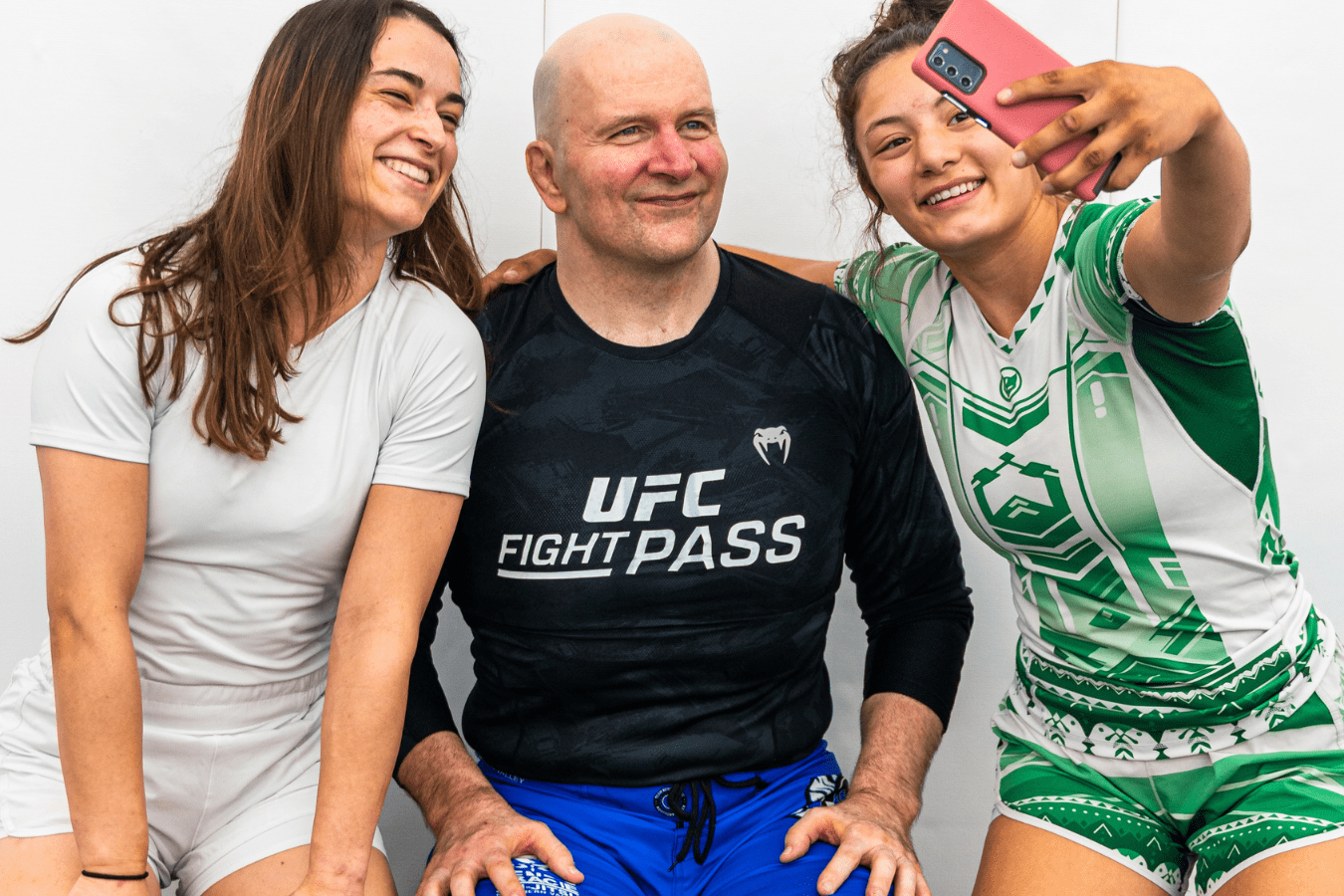
The fastest way to level up your communication is to practice it under pressure, with a partner who wants to win too.
In Austin, it is normal to chase better fitness, sharper focus, and a stronger routine all at once. What surprises many new students is how quickly martial arts training starts changing the way you work with people, not just how you move. When you train with partners every class, you cannot hide behind “I will figure it out later” energy. You have to communicate, adapt, and stay respectful while you solve problems in real time.
We see it every week: people show up for the workout and stay because training becomes a practical social skill lab. You learn how to read body language, give and receive feedback, and keep your cool when something gets uncomfortable. That is teamwork, just in a rashguard instead of a meeting room.
Our approach is built around Brazilian Jiu-Jitsu, where partner drilling and live rounds create a structured environment for personal growth. And because our training is technical and organized, you are not relying on athletic talent to “fit in.” You are relying on consistency, curiosity, and the willingness to learn with other people.
Why martial arts naturally builds better teamwork
Teamwork is not just being nice. Real teamwork is shared problem-solving with limited time, imperfect information, and a little stress in the mix. Martial arts gives you all of that in a controlled setting, with clear rules and coaching that keeps things productive.
In grappling, you and your partner are constantly exchanging information through pressure, balance, grips, breathing, and timing. If you rush, you get off-balance. If you freeze, you get stuck. The lesson is simple: collaboration works better than stubbornness, even when you are technically “competing” during rounds.
Partner drilling teaches coordination, not just technique
Drilling is where teamwork shows up quietly. You and a partner repeat a movement, troubleshoot details, and adjust until it works. That process trains a few useful habits you can carry into everyday life:
• You learn to ask clear questions instead of guessing and hoping
• You practice giving specific feedback without getting personal about it
• You get used to small corrections, because small corrections are how you improve
• You start noticing patterns, which makes you better at anticipating needs on a team
This is one reason martial arts feels different from many solo workouts. You cannot fully do it alone, so your progress becomes connected to how well you train with others.
Live rolling develops trust under pressure
In live rounds, trust is not a vague concept. You trust your partner to train hard without being reckless. You trust yourself to stay calm when you are in a bad position. You trust the room, the rules, and the coaching to keep the pace intense but safe.
That trust is built through repetition. Each class is a small vote in favor of “we can do hard things without turning it into drama.” Over time, it changes how you show up in group settings outside the gym too. You become more willing to collaborate, more comfortable with accountability, and less reactive when plans change.
Martial arts in Austin, TX and the social side of showing up
Austin moves fast. Work calendars fill up, traffic is what it is, and it is easy to go days without a real face-to-face conversation that is not a Slack message. Training gives you a place where people actually look each other in the eye, learn names, and put in effort together.
Martial arts in Austin, TX also attracts a mix of personalities, which is a hidden advantage. You might train next to someone in tech, healthcare, trades, or creative work, and you end up building social flexibility without forcing it. You are not networking. You are just training. The friendships come as a side effect.
A structured room makes social skills easier for beginners
A lot of adults worry that starting martial arts means walking into a room of confident extroverts who already know what they are doing. We build class structure to remove that pressure. You do not need to be naturally social to benefit from a social environment. You just need a clear plan, a coach guiding the room, and partners who understand what it feels like to be new.
Because classes follow a consistent rhythm, you always know what to do next: warm-up, technique, drilling, rounds, and wrap-up. That rhythm reduces awkwardness. You can focus on learning and let conversation happen naturally, usually between rounds when people are catching their breath and laughing a little at how hard grappling can be.
How Brazilian Jiu-Jitsu translates to workplace teamwork
Brazilian Jiu-Jitsu is problem-solving with immediate feedback. If you try a shortcut, it fails. If you panic, you gas out. If you stay patient and use good mechanics, you improve. That is not far from how projects work, especially in collaborative Austin work cultures where people juggle fast timelines.
Here are a few direct parallels we watch students develop over time:
Communication that stays calm and specific
Good training partners communicate with simple, useful language: “Start here,” “Control this grip,” “Slow down,” “Try it again.” That habit transfers. In a meeting or on a team call, you get better at saying what you mean without adding extra heat.
You also learn to listen differently. In martial arts, ignoring feedback has consequences. So you get used to treating coaching and partner input as information, not criticism.
Adaptability when the plan breaks
No roll goes exactly the way you imagine. Your partner reacts, counters, and changes angles. You learn to adjust mid-stream rather than mentally restarting every time something goes wrong. That is a teamwork superpower.
In group projects, the same skill matters. Requirements change. A teammate gets sick. The timeline shifts. BJJ training makes “adapt and keep moving” feel normal instead of stressful.
Shared responsibility and healthy accountability
In training, you are responsible for your pace, your safety, and the quality of the round. If you are careless, it affects someone else. If you are checked out, your partner’s practice suffers too. That creates a steady sense of responsibility without anyone needing to lecture you.
Over time, you start taking ownership in other settings more naturally. You follow through. You show up. You communicate when you cannot. It is not dramatic, but it is real.
Social skills you build without forcing small talk
People often think social skills mean being charming. We see it differently. Social skills are the ability to handle real interactions well: uncertainty, feedback, disagreement, humor, and boundaries. Martial arts puts you in those situations regularly, but with a clear purpose and a shared activity.
Reading cues and respecting boundaries
In grappling, body language matters. You learn when a partner is pushing the pace, when someone is tired, and when you need to lighten up. You learn to match intensity appropriately. That skill is huge in everyday life, especially in group environments where people have different comfort levels.
You also practice boundaries in a normal, healthy way. If you need to pause, reset, or ask a question, you learn to speak up. And because that is common in class, it feels natural instead of awkward.
Humor and resilience in real time
Some rounds are messy. Sometimes you get stuck. Sometimes you do everything “right” and still end up tapping. If you train consistently, you get comfortable laughing, learning, and moving on.
That resilience shows up socially too. You take yourself less seriously in the best way. You can recover from minor embarrassment, handle a disagreement, and keep the tone friendly without avoiding the issue.
What you can expect from our adult training programs
Most adults want three things from martial arts: a clear starting point, consistent coaching, and a room that feels welcoming without being weird about it. We design our adult programs to deliver that, especially for beginners who want a strong foundation.
Our Fundamentals Program is built for all experience levels. You do not need an athletic background. You do not need to “get in shape first.” You start where you are, learn the essential positions and principles, and build confidence through steady practice.
A simple progression that keeps you improving
We focus on clarity and real-world application. That means we keep technique organized, we emphasize details that actually work, and we encourage questions. You will drill with different partners, which helps you learn to communicate with different styles and sizes, not just someone who moves exactly like you.
You will also see how we use coaching feedback in the moment. Corrections are normal here. Nobody gets singled out. We just keep things moving so you can learn faster.
Community events that reinforce connection
Training is the core, but community matters too. Open mats, group training sessions, and local events give you more chances to build camaraderie. These moments tend to make the social benefits stick because you see people outside the strict “class format,” still connected by the same shared practice.
And yes, sometimes it is as simple as staying a few extra minutes to talk after class. That is often where new students realize they already feel more comfortable than they did a month ago.
A practical checklist for turning training into better teamwork
If your goal is stronger teamwork and social skills, consistency matters more than intensity. Here is a straightforward way to get more out of your training week:
1. Train on a predictable schedule so partners recognize you and rapport builds naturally
2. Choose one communication goal per class, like asking one question or requesting one correction
3. Rotate partners when appropriate to practice adaptability and comfort with new people
4. After a round, share one specific takeaway with your partner, not a vague “good round”
5. Keep a short note on what worked so you can bring it back next class without overthinking
None of this requires being outgoing. It just requires showing up and participating with intent.
Ready to Transform Your Teamwork in Austin
Building better teamwork is not about memorizing communication tips. It is about practicing communication in a place where it matters, then carrying those habits back into your day. That is exactly why we run our classes the way we do: technical, structured, and partner-focused, so you improve your martial arts skills and the way you relate to people at the same time.
If you want a training environment in Austin, TX where the details are taken seriously and the culture stays grounded, we would like to help you get started. Simple Man Martial Arts is here to give you a clear path from day one, whether you are brand-new or returning to training after time away.
No prior experience is necessary. Join a martial arts class at Simple Man Martial Arts today.