Master these five basics first, and everything else in your training starts to feel easier and more natural.
Starting Martial Arts in Austin can feel like stepping into a brand-new language: new stances, new terms, and a whole lot of motion happening at once. We see it all the time. Beginners usually do not need more techniques. You need the right first techniques.
In our classes, we focus on fundamentals that give you real traction early: striking that is safe and controlled, movement that keeps you balanced, and defense that helps you stay calm under pressure. Flashy moves can come later. The basics are what make you functional.
Below are five beginner-friendly moves we want you to master first if you are training Martial Arts in Austin, TX for self-defense, fitness, confidence, or all three.
What makes a move worth learning first?
A good first move does at least one of these things: it protects you, it helps you move better, it makes your strikes land cleaner, or it keeps you stable when things get messy. The best beginner moves also stack together, so your training feels connected instead of random.
We also teach in a practical order that builds skill faster:
- Striking fundamentals first, because most beginners can learn distance and timing quickly
- Takedown and balance concepts second, because staying upright matters
- Ground survival basics third, because you want options if you end up down
That layered approach is a big reason beginners tend to feel progress within the first few weeks, instead of feeling lost.
Move 1: Athletic stance and a consistent guard
If you only learn one thing in your first week of Martial Arts, make it this: a stance you can actually hold and a guard you remember to keep up. Your stance is your base. Your guard is your seatbelt.
What it looks like
We teach a simple, athletic stance: knees soft, feet under you (not on a tightrope), chin slightly tucked, hands up where you can protect your head and frame against contact. Nothing fancy. Just stable.
Why it matters in real life and in training
A good stance helps you:
- Generate power without over-swinging
- Stay balanced when you miss, slip, or get bumped
- Move your head off the center line without falling into the floor
- Keep your hands in position to defend quickly
Most beginner problems come from posture and spacing, not lack of courage. When your stance is right, you breathe easier. That sounds small, but it changes everything.
Common beginner mistakes we coach immediately
Beginners often stand too tall, lock the knees, cross the feet, or let the hands drift down while thinking. Our job is to help you build the habit so you do not have to think about it later.
Move 2: Footwork you can repeat under pressure
In Martial Arts in Austin, the students who improve fastest are rarely the ones who hit hardest on day one. It is usually the students who learn to move well. Footwork is how you control distance, timing, and safety.
The core footwork pattern we build first
We start with step-and-drag movement (sometimes called push step): when you move forward, the front foot steps and the back foot follows. When you move back, the back foot steps and the front foot follows. Your feet keep the same relationship, and your stance stays intact.
We also layer in small pivots, because turning the corner matters for both striking and defense.
Why footwork is a beginner superpower
When your feet behave, you can:
- Stay in range long enough to land clean shots
- Exit safely without turning your back
- Avoid collisions during drills and partner work
- Keep your balance when you get surprised
This is one of those skills that feels boring until you notice how often it saves you. Then it becomes kind of addictive.
Move 3: The jab-cross (done clean, not wild)
If we had to pick the most useful two punches for beginners, it is the jab and the cross, taught with correct alignment and a calm tempo. The jab is your measuring stick. The cross is your straight-line power.
This is also where many people first feel what Martial Arts is supposed to feel like: coordinated, grounded, and sharp, not frantic.
Jab fundamentals we expect you to build
A good jab is not a slap. We focus on:
- Shoulder protecting your chin as the hand extends
- Elbow tracking behind the fist, not flaring out
- A quick return to guard (the punch is not finished until you are back)
Cross fundamentals that keep you safe
With the cross, we teach hip rotation and weight transfer without lunging. Overreaching is the fast track to losing balance, especially when you are tired.
How this connects to self-defense and fitness
Even if your goal is mainly fitness, jabs and crosses teach timing, coordination, and conditioning. If your goal is self-defense, straight punches are easier to land under stress than complicated combinations. We keep it practical.
Move 4: Basic defense: cover, parry, and head movement
Beginners often worry about getting hit, and that is a reasonable concern. We address it early by teaching simple, high-percentage defense that you can perform even when your brain is busy.
Defense is not one move, but we teach it as a small toolkit that works together.
The three defenses we rely on early
1. Cover: using your forearms and gloves or hands to protect your head while staying stable
2. Parry: redirecting straight shots just enough to miss, without chasing the punch
3. Head movement: small slips, not dramatic ducking, keeping your eyes on the target
We train these at controlled speed first, then gradually add more realism as your comfort grows.
Why defense belongs in beginner training
If you only learn to strike, you tense up the moment contact shows up. When you learn defense early, you stay present. You make better decisions. You also avoid the bad habit of closing your eyes or turning away.
And yes, defense is tiring at first. That is normal. You are building new reflexes.
Move 5: Breakfalls and getting back up safely
If striking is the front door of Martial Arts, falling safely is the side door that keeps you from getting hurt. In real life, falls happen. In training, beginners can trip, get bumped, or lose balance during drills.
We teach breakfalls and stand-ups because safety is not optional.
What we mean by breakfalls
Breakfalls are controlled ways to hit the ground with less risk. Depending on the drill, we teach:
- Back breakfalls: chin tucked, controlled slap, rounded back
- Side breakfalls: landing on the side of the body, not on the elbow or shoulder point
- Forward breakfalls or postings: learning where not to catch yourself
We keep this progressive. You do not start by getting thrown hard. You start by learning the shapes, the timing, and the confidence to hit the mat safely.
The beginner stand-up rule we emphasize
Getting up is part of self-defense. We teach a stand-up that keeps your eyes forward and your base under you, instead of turning away or standing with your feet tangled.
This is the bridge into takedown defense and ground survival later, but it is valuable immediately.
What your first class usually feels like
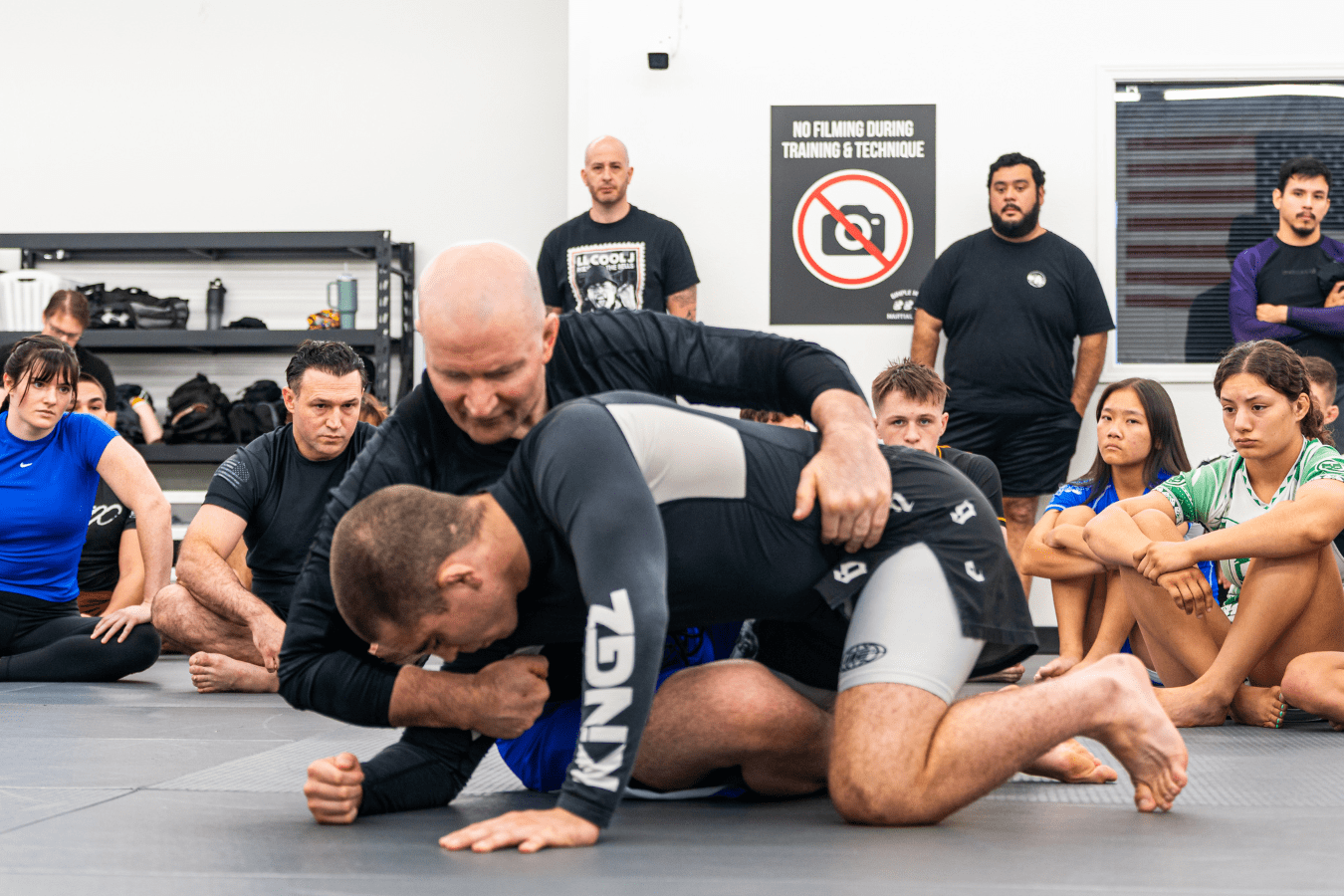
Most beginners are surprised by how structured a good class feels. You will warm up, practice a few skills with coaching, and do drills that match your level. We are not trying to overwhelm you. We are trying to help you leave class feeling like, OK, I can do this.
A typical session includes:
- Warm-up that builds mobility, core strength, and joint readiness
- Technical practice of one or two core skills (like stance and jab-cross)
- Partner drills with clear rules and light contact when appropriate
- Conditioning that supports technique, not just exhaustion
- A short cool down and questions at the end
If you are nervous, that is normal. We build confidence through repetition and a room culture where beginners are not treated like interruptions.
What to bring, how often to train, and what to expect
Austin schedules are busy, so we design training to fit real life. Consistency beats intensity, especially early.
What to bring to your first session
Keep it simple:
- Comfortable workout clothes you can move in
- A water bottle
- A small towel if you tend to sweat (most people do)
- An open mind and a willingness to ask questions
Gear needs vary by class type, but you do not need to buy a closet full of equipment before you know you enjoy training. We will guide you.
How often you should train as a beginner
For most people, 2 to 3 classes per week is the sweet spot. It is enough to build skill without feeling like a second job. If you can only do one day some weeks, we would rather you show up once consistently than disappear for a month.
Realistic progress in 30, 60, and 90 days
Progress looks different for everyone, but here is a practical timeline we see often:
• 30 days: you remember your stance and guard, your jab-cross feels less awkward, and your breathing is calmer during drills
• 60 days: your footwork is more automatic, your defense reactions start to show up, and you can do longer rounds without panic fatigue
• 90 days: you start chaining skills together, you spot openings more clearly, and you feel noticeably more capable in both fitness and self-defense contexts
That is the quiet win of Martial Arts in Austin: you do not just get tougher, you get sharper.
How these five moves fit together (and what comes next)
These moves are not random. They are a system:
- Stance and guard give you structure
- Footwork gives you control of distance
- Jab-cross gives you clean offense
- Defense gives you safety and composure
- Breakfalls and stand-ups give you confidence when balance changes
Once those pieces are in place, we can build combinations, add kicks or knees as appropriate, and introduce takedown defense and ground skills in a way that feels logical. That is when training gets fun in a new way, because you are not just copying moves, you are understanding them.
Ready to Begin
Building a strong foundation is the fastest way to feel at home in Martial Arts, and it is exactly how we teach at Simple Man Martial Arts. When you start with stance, movement, clean striking, basic defense, and safe falling, you stop guessing and start building skills you can actually use.
If you are looking for Martial Arts in Austin, TX that keeps beginners progressing without feeling thrown into the deep end, we would love to show you how our classes are structured and what your first few weeks can look like.
Turn what you learned here into hands-on training by joining a martial arts program at Simple Man Martial Arts.